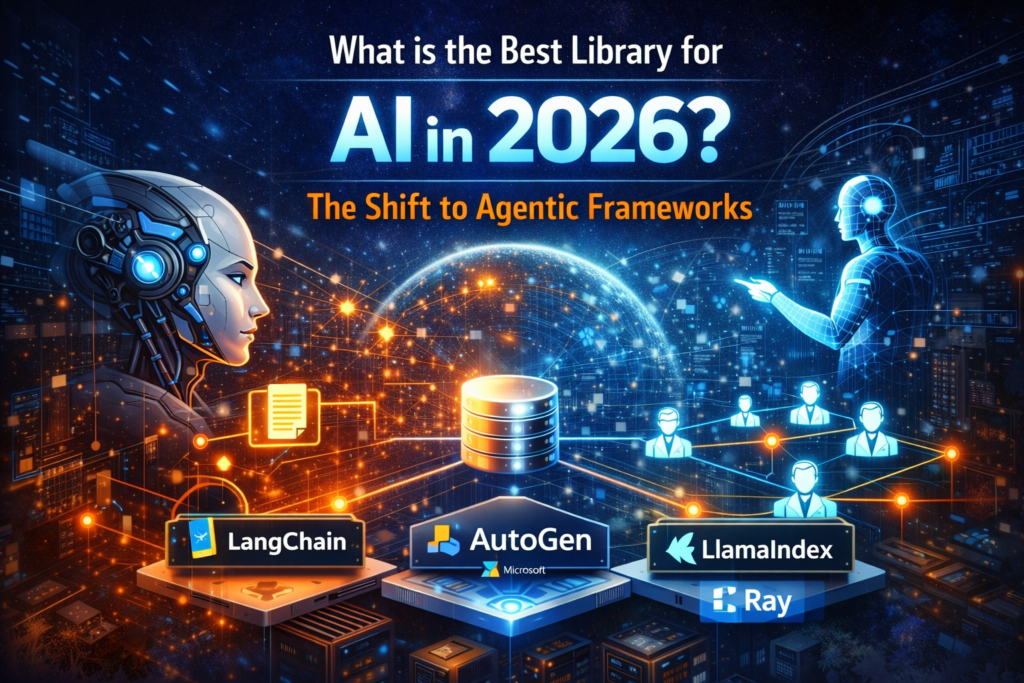
Artificial Intelligence in 2026 is no longer defined by who has the biggest model. The real competition has moved one layer up — to how intelligence is orchestrated, controlled, and deployed. This is where agentic frameworks have become the most important evolution in modern AI development.
If you are a developer, architect, startup founder, or tech lead asking “Which AI library should I invest in for the future?” — this article will give you a clear, practical answer.
For the complete technical breakdown and architecture insights, you can also read the original post here:
https://kaundal.vip/what-is-the-best-library-for-ai-in-2026/
Why the Definition of “Best AI Library” Has Changed
Until recently, choosing an AI library meant picking a model framework: TensorFlow, PyTorch, or a fine-tuning toolkit. That era is over.
In 2026, real-world AI systems must:
Plan tasks across multiple steps
Use tools like APIs, databases, browsers, and code execution
Coordinate multiple AI agents with specialized roles
Run safely, reliably, and cost-effectively in production
This shift has created a new category: agentic AI frameworks — libraries that turn large language models into autonomous, goal-driven systems.
What Are Agentic Frameworks?
Agentic frameworks are AI libraries designed to let models act, not just respond.
They enable AI systems to:
Decide what to do next
Call tools and verify results
Collaborate with other agents
Maintain memory and context over time
Recover from errors and retry intelligently
Instead of a single prompt → response loop, you get reasoning → planning → execution → feedback.
This is why agentic frameworks define the AI stack of 2026.
The Top AI Libraries Dominating 2026
1. LangChain – The Most Practical Agent Framework
LangChain has become the default choice for building production-ready AI agents.
Why it stands out:
Strong integrations with LLM providers
Tool calling, memory, and agent workflows built-in
Large ecosystem and community adoption
Suitable for startups and enterprises alike
If you want to go from idea to deployed agent quickly, LangChain is often the safest choice.
2. AutoGen (Microsoft) – Best for Multi-Agent Systems
AutoGen focuses on structured agent-to-agent collaboration.
Its strengths include:
Clear role separation between agents
Controlled communication patterns
Ideal for research assistants, simulations, and complex workflows
If your system requires multiple AI agents working together, AutoGen excels.
3. LlamaIndex – Best for Document and Knowledge Agents
LlamaIndex dominates when your AI needs to work deeply with documents.
It is especially strong for:
Enterprise knowledge bases
Document search and reasoning
Retrieval-augmented generation (RAG)
Internal company data agents
For document-centric AI products, LlamaIndex is often the best foundation.
4. Hugging Face Ecosystem – Research and Custom Models
Hugging Face continues to play a critical role in:
Model experimentation
Fine-tuning and evaluation
Open-source agent research
If your work involves training or modifying models, Hugging Face remains essential — even when paired with other agent frameworks.
5. Ray – Scaling Agentic AI in Production
As agent workflows grow more complex, execution becomes the bottleneck.
Ray solves this by enabling:
Distributed execution
Parallel agent workflows
Scalable production deployments
Ray is not an agent framework itself, but it is often the backbone of serious agent systems in production.
So… What Is the Best AI Library in 2026?
The honest answer: there is no single best library — only the best stack.
However, if you need a starting point:
LangChain is the best general-purpose agent framework
AutoGen is best for multi-agent coordination
LlamaIndex is best for document-driven AI
Ray is best for scaling agent workloads
The future belongs to composable AI stacks, not monolithic tools.
Why Agent Interoperability Matters
A major trend in 2026 is the push toward agent standards and interoperability. Instead of locking into one ecosystem, modern AI systems are built by combining:
Agent frameworks
Execution engines
Model providers
Observability and safety layers
This flexibility is what future-proofs AI products.
Final Thoughts
If you are still choosing AI libraries based only on model quality, you are already behind.
In 2026, the real winners are teams who:
Design autonomous agent workflows
Embrace tool-using AI
Focus on orchestration, safety, and scale
Agentic frameworks are not a trend — they are the new foundation of applied AI.
For a deeper technical dive and architecture examples, read the full article here:
https://kaundal.vip/what-is-the-best-library-for-ai-in-2026/
🚀 Join the Community & Stay Connected
If you found this article helpful and want more deep dives on AI, software engineering, automation, and future tech, stay connected with me across platforms.
🌐 Websites & Platforms
Main platform → https://pro.softwareengineer.website/
Personal hub → https://kaundal.vip
Blog archive → https://blog.kaundal.vip
🧠 Follow for Tech Insights
X (Twitter) → https://x.com/k_k_kaundal
Backup X → https://x.com/k_kumar_kaundal
LinkedIn → https://www.linkedin.com/in/kaundal/
Medium → https://medium.com/@kaundal.k.k
📱 Social Media
Threads → https://www.threads.com/@k.k.kaundal
Instagram → https://www.instagram.com/k.k.kaundal/
Facebook Page → https://www.facebook.com/me.kaundal/
Facebook Profile → https://www.facebook.com/kaundal.k.k/
Software Engineer Community Group → https://www.facebook.com/groups/me.software.engineer
💡 Support My Work
If you want to support my research, open-source work, and educational content:
Gumroad → https://kaundalkk.gumroad.com/
Buy Me a Coffee → https://buymeacoffee.com/kaundalkkz
Ko-fi → https://ko-fi.com/k_k_kaundal
Patreon → https://www.patreon.com/c/KaundalVIP
GitHub Sponsor → https://github.com/k-kaundal
⭐ Tip: The best way to stay updated is to bookmark the main site and follow on LinkedIn or X — that’s where new releases and community updates appear first.
Thanks for reading and being part of this growing tech community!
Comments
Post a Comment